
Home

Research & Contributions
Explore our Research and see how we turn complex challenges into intelligent Ideas.
Our IT Research portfolio showcases cutting-edge solutions developed across diverse industries, including healthcare, finance, education, manufacturing, energy, and enterprise operations. With expertise in AI/ML, Software Engineering, Data Analytics, IoT, and Cloud Technologies, we build systems that enhance efficiency, improve user experience, and drive digital transformation.
Every project is driven by research, innovation, and a strong engineering mindset — delivering results that matter.

Research Papers
An Experimental Study on Machine Learning Techniques to Predict Alzheimer Disease
Publisher: IEEE , ResearchGate
Author:
Alina Baber; Syed Muhammad Nabeel Mustafa; Maria Andleeb Siddiqui;Muhammad Naseem; Tauseef Mubeen
Industrial Collaborator: Alphatron Technologies Private limited
Abstract:
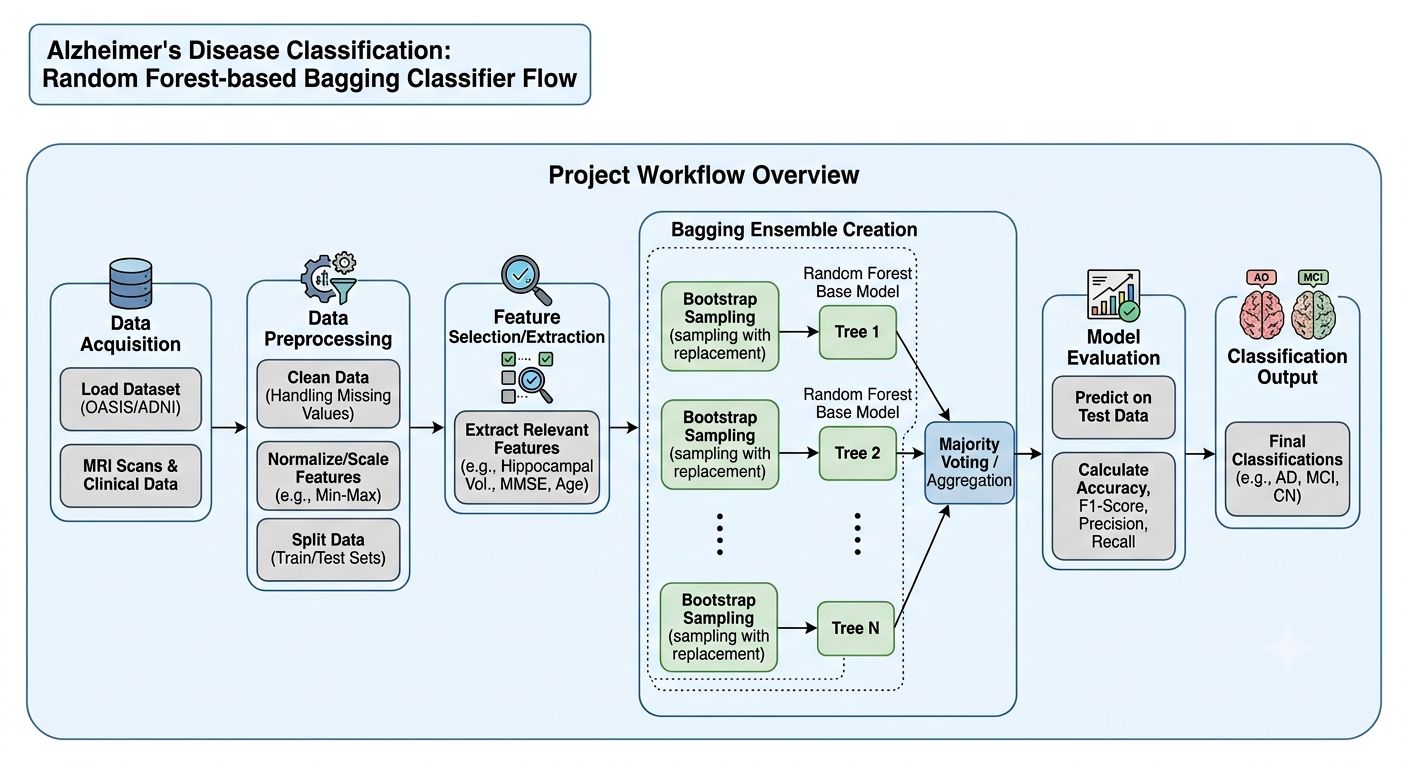
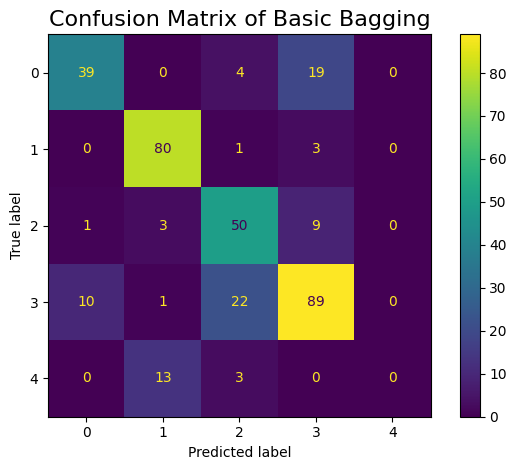
Artificial intelligence (AI) has significantly advanced medical science in recent years, especially through the use of machine learning to diagnose serious diseases prone to human error. Recent progress in computer vision has improved the accuracy of interpreting magnetic resonance imaging (MRI) scans, thereby aiding critical diagnoses. This study introduces a hybrid approach for classifying MRI scans of brains with Alzheimer’s disease and those of cognitively normal brains. The method involves two steps: first, extracting features with various deep learning models such as VGG19, ResNet20, DenseNet121, InceptionResNetV2, and InceptionV3; second, using a support vector machine (SVM) to classify the extracted features. Experimental results show that ResNet20 + SVM achieves 95% accuracy, DenseNet121 + SVM and InceptionResNetV2 + SVM reach 98% accuracy, VGG19 + SVM achieves 79% accuracy, and InceptionV3 + SVM results in no accuracy. Compared to other current research, these findings highlight the reliability and effectiveness of the proposed hybrid method.
Fingerprint generation and authentication though Adaptive convolution generative adversarial network (ADCGAN)
Publisher: IEEE , ResearchGate
Author:
Alina Baber; Syed Muhammad Nabeel Mustafa; Syeda Sundus Zehra; Maria Andleeb Siddiqui
Industrial Collaborator: Alphatron Technologies Private limited
Abstract:
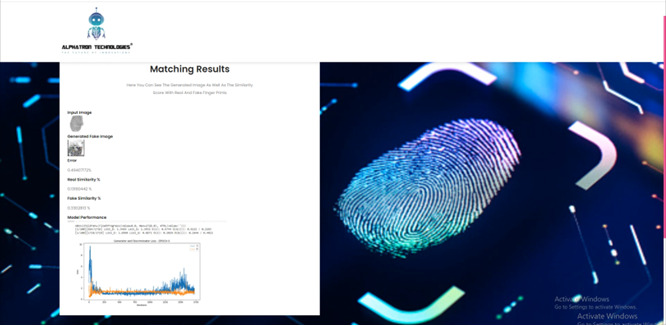
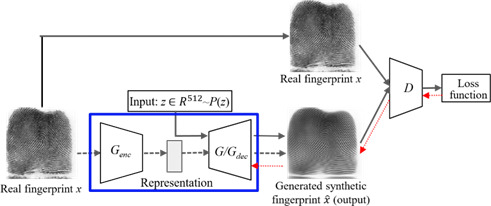
Fingerprints are crucial in identification of humans. The uniqueness of finger prints makes it an interesting subject. Fingerprints are termed as a technique used to define, assess, and quantify a person’s physical and behavioral property. Deep learning has made its application in all the major fields such as natural language processing, computer vision and speech processing. Deep learning has also found its application in the important subject of fingerprint synthesis and biometric. The ever-growing complexity of fingerprint authentication issues, from cellphone authentication to airport security systems, seems to be best handled by these models. In recent years, deep learning-based models have been used more and more to raise the accuracy of various fingerprint recognition systems. The persuasive capacity of Generative Adversarial Networks (GANs) to generate believable instances can be credibly taken from an existing distribution of samples. GAN exhibits exceptional performance on data generation-based tasks and also encourages study in privacy and security. In this work, using Adaptive Deep Convolution Generative Adversarial Networks (ADCGAN), we develop a model that generates and authenticate the fingerprints. A Socofing dataset was trained on ADGAN model. The model gave 92% accuracy. The conduct of fingerprint research has been made possible due to ADGAN, without restrictions related to the confidential nature of biometric data.

Want to learn more about how these Researches?

We’re here to help.
Click below to connect with our team.
